Comments
Check out our elevator pitch or sign in
Next Up...
The Rosicrucian Library Volumes
This document synthesizes the core themes, historical claims, and philosophical principles presented in excerpts from “The Rosicrucian Library Volumes."
https://archive.org/details/the-rosicrucian-library-volumes/page/n5/mode/2up
The material traces the origins and history of the Rosicrucian Order (AMORC), outlines its core tenets through a question-and-answer format, and provides detailed instruction on mystical psychology for self-mastery. A significant portion is dedicated to a reinterpretation of the life and mission of Jesus, positioning him as an initiate of the Great White Brotherhood and the founder of a secret school whose teachings persist. Further volumes explore the doctrine of reincarnation through narrative and provide frameworks for understanding the cyclical laws of fate and destiny.
The central thesis is that the Rosicrucian Order is the modern heir to an ancient tradition of mystical knowledge originating in Pharaonic Egypt. This tradition, stewarded by the Great White Brotherhood, preserves secret teachings on cosmic laws, reincarnation, Karma, and the nature of the Divine Self within each human. The philosophy presented is not merely theoretical but is a practical system for achieving self-mastery, health, and success by aligning with these universal principles. The texts assert that Jesus's true mission was to establish a secret society to preserve and transmit these mysteries, claiming that he did not physically die on the cross but was rescued by Essene brethren, and that his teachings were deliberately veiled or concealed by later ecclesiastical authorities.
History of the Order
This volume presents the official history of the Rosicrucian Order, tracing its lineage from ancient mystery schools to its modern incarnation as the Ancient Mystical Order Rosae Crucis (AMORC).
Ancient Origins in Egypt
• The Great White Brotherhood: The foundation of the Order is traced to a secret society of "truly great minds" in ancient Egypt, which became known as the Great White Brotherhood.
• Pharaoh Ahmose I: The first Pharaoh to conduct the Brotherhood's classes in his private chambers was Ahmose I, who reigned from 1580 B.C. to 1557 B.C.
• Amenhotep IV: A central figure and "Master" of the Order, Amenhotep IV is lauded for establishing a monotheistic religion centered on Aton (the sun's symbol for the true God). His religion is described as "a flash of blinding light in the night time," which signaled future Western religions. His focus on spiritual matters at the expense of political ones led to a decline in his health, and he passed away in July 1350 B.C. Egyptologist James Breasted is quoted as calling him "the world's first individual."
• Hermes: Following Amenhotep IV, a sage named Hermes produced many mystical writings, veiled so as to be of value only to future initiates.
Structure and Expansion
• Dual Congregation: The Great White Brotherhood has always functioned with a dual structure:
Inner Congregation: Comprised of secret schools, temples, high priests, and students.
Outer Congregation: Public-facing movements designed to veil the inner work, such as the Essenes in Palestine and the Therapeuti in Greece. The "Christine movement" is also listed among these bodies.
• The Great White Lodge: After a period of contention, the Brotherhood withdrew from public activity and a council of advisors constituted the esoteric body known as the Great White Lodge.
• Growth and Persecution in Egypt: The Order experienced tolerance during the XIX dynasty under Seti I and Rameses II, but a growing feeling against its "secret power" forced its activities to become more clandestine.
• Spread to Europe: The Order was introduced to Germany by Charlemagne. A Grand Lodge was established in Worms in 1100. The work grew rapidly but secretly during the twelfth century before entering another period of dormancy in the early fifteenth century.
Cycles and Key Symbols
• The 108-Year Cycle: The history of the Order is governed by a mysterious law of 108-year cycles, which account for periods of public activity followed by periods of quietude and dormancy.
• C. R-C.: This is not the name of a single individual but a symbolic title for the reincarnated personality of the Order's Imperator for a given cycle. The text states that records show at least twelve discoveries of the "tomb" of C. R-C. in different lands prior to the well-known 17th-century incident in Cassel, Germany.
• The Role of the Printing Press: The widespread attention the Order received in the 17th century was largely due to the use of the printing press, which allowed for the distribution of manifestos in five languages. This unique publicity attracted both interest and criticism.
The Modern Order: AMORC
• Official Name: The correct name for the international organization is the Ancient Mystical Order Rosae Crucis (AMORC), an abbreviation of the original Latin Antiquae Arcanae Ordinis Rosae Rubeae et Aureae Crucis. It is asserted that AMORC is the only organization that uses the ancient title "Rosicrucian Order."
• American Jurisdiction: The modern cycle of the American Order began under the sponsorship of the French jurisdiction ("Rose Croix"). It grew rapidly, establishing branches from coast to coast by 1916 and holding its first National Convention in Pittsburgh in the summer of 1917.
• International Recognition: The American branch received papers of approval and recognition from French Rosicrucian officers, such as Monsieur Verdier, and was later appointed a branch of the international body by a convention held in Switzerland.
Questions and Answers
This section clarifies the Order's philosophy, structure, and practices in a direct question-and-answer format.
Organization and Membership
• Leadership: All officers are elected and hold no position by "super virtue or Divine decree." There is no requirement to pledge personal allegiance to any founder or leader.
• Membership Terms: Members are free to join and just as free to resign at any time. There are no lifetime oaths.
• Personal Freedom: Nothing is asked of a member that would interfere with their religious, political, social, or moral obligations to God, family, or country.
• Financial Structure: AMORC operates on a dues system that covers all benefits, including weekly private instructions, personal letters of advice, and lodge affiliation, without requiring the purchase of books. This is contrasted with organizations that solicit "voluntary donations" but then require members to buy numerous expensive books. An attempt to operate on a voluntary basis was deemed unsuccessful.
Core Philosophical and Mystical Tenets
• On Diet: The idea that eating animal flesh adds "lower vibrations" is dismissed as "purely theoretical." The divine essence of the soul cannot be charged or modified by anything one eats or drinks. Spiritual development is defined as the "development of his comprehension, understanding, and domination of himself," not a change in the soul essence.
• On Evil: The text posits that "Everything that is, is good," and that cataclysmic events are part of a process of reconstruction. The idea that "malignant thinking" can affect the earth is called a "superstitious idea" held over from a time when unpleasant events were attributed to demons.
• Mysticism Defined: Mysticism is the profound inquiry "into the origin of things, the mystery of life, and the ultimate purpose of our existence." It is not magic. It is described as the essence of religion and the fabric from which artists, inventors, and other creators weave their inspired impressions.
• On Reincarnation: The doctrine does not claim that every living being has lived before. The text states it is "very possible" that primitive peoples discovered in uncivilized lands are "new soul expressions having their first incarnation."
• Progressive Teachings: The Order's teachings are not static. They are continually updated with new principles and discoveries tested by the highest members, ensuring students receive the "most modern application of the fundamental principles."
Mystical Principles for Self-Mastery
This section synthesizes teachings on the practical application of mystical and psychological principles for achieving success in life.
Concentration and Affirmations
• The Truth About Affirmations: The popular Western understanding of affirmations, exemplified by Émile Coué, is critiqued as a misunderstanding. True mystics do not affirm the existence of a condition that is not real (e.g., affirming health while sick). Instead, they deny the power of negative conditions to enslave them and affirm that these conditions "shall not continue to be."
• Effective Concentration: A distinction is made between "concentrating upon a dream" and "concentrating upon building that dream into realization." True concentration is active and involves talking, thinking, and acting upon the goal every waking moment.
• Identifying the Real Desire: Individuals often mistake the means for the end. For example, one might concentrate on getting money when the real need is a new coat or a child's education. It is crucial to focus on the primary need and leave the method of its fulfillment to the Cosmic.
Cosmic Law in Business and Finance
• Ethical Petitions: The Cosmic is generally "not in sympathy with the use of money." When seeking cosmic aid for financial matters, petitioners must come with "clean hands." The money must be justly due, ethically untangled, and not bring sorrow to others.
• Ethical Borrowing: Borrowing money is considered ethical for necessities, such as clothing, food, rent, education, or sound business investments. Borrowing for luxuries or speculative ventures is seen as a risk and indicative of poor personal priorities.
• The Law of Compensation: A narrative about a wealthy man, Mr. William Woodbury, illustrates this principle. He set aside $1,000,000 to loan, without interest or security, to worthy individuals starting their own businesses. As a result, his other business affairs began to "prosper far beyond his anticipation," demonstrating the cosmic law that rewards selfless help to others.
• Attracting Business: The key to success is to provide "plus" service—giving customers things "he or she did not pay for, did not expect, and which do not have any material price attached to them." The example of the Venetian Theatre illustrates how an investment in politeness, unique methods, and a quality product can build a successful business against stiff competition.
The Inner Self and Mastership
• Mind-Body Connection: A person's thoughts, beliefs, and actions have as much effect on health and personal problems as physical factors. It is futile to try to help a person who continues to operate on "false, erroneous, or inharmonious ideas."
• The Divine Self: To be successful, one must cease feeling like an isolated individual and develop a sense of "oneness with God and oneness with humanity." The Divinity within is the only real part of our existence; it is unlimited, omnipotent, and its trend is always "upward and progressive." The outer, physical self should be its servant.
• Mystical Ethics: The mystic's understanding of Karma and compensation leads to a clear and definite obedience to cosmic law, which is more compelling than mundane human laws. Being true to the inner self is the key to success and happiness in all affairs.
The Mystical Life of Jesus
This extensive work presents a version of Jesus's life based on Rosicrucian and Essene records, offering an alternative to orthodox Christian accounts.
Origins and Education
• Essenian Background: Jesus's parents, Mary and Joseph, were Gentiles of Galilee and members of the Essene community. The term "Nazarene" is presented not as a resident of Nazareth, but as a member of a non-Jewish mystical sect.
• The Virgin Birth: This event is described as a well-understood mystical principle in the Orient, not a unique occurrence. The text states Jesus was not the first avatar to be "born of a virgin." The birth itself took place in a well-appointed Essenian grotto, or hospice, near Bethlehem on the winter solstice (December 25), a date noted as the cosmic period for the birth of avatars long before the Christian era.
• Education at Mount Carmel: Jesus was highly educated. He received preliminary instruction at a great school and monastery maintained by the Essenes and Nazarenes on Mount Carmel, referred to as "the school of the prophets."
• Visit to the Jerusalem Temple: At age twelve, Jesus astonished the learned doctors not with rote answers but with a profound mystical insight that revealed his advanced education at Carmel. He stated his intention to visit higher schools in foreign lands.
• Initiation in Egypt: Jesus traveled to Heliopolis in Egypt, the location of the Supreme Temple. There, he entered the secret priesthood and underwent a series of initiations and symbolic tests to prepare him for his mission. The forty days in the wilderness is interpreted as a period of meditation upon the temptations he would face during his ministry.
Mission and Secret Teachings
• The Secret School: Jesus established a secret society of 120 initiated members to preserve his true teachings. This group included his mother, Mary, as well as his brothers and sisters.
• Method of Teaching: He taught the multitudes in parables but revealed the deeper "mysteries of the Kingdom of Heaven" only to his initiated disciples in private.
• The Moral Code: Jesus taught a mystical moral code that had existed in mystery schools for ages. This code held the evolving inner self (the personality) responsible for sin, not the immortal soul (which is part of God and cannot sin) or the transient physical body.
• Transference of Power: At the Last Supper, Jesus transferred his divine power and authority to his disciples, empowering them to heal, cleanse lepers, and cast out demons.
The Crucifixion and Resurrection
• Concealment of Facts: The text claims that early Christian church councils deliberately destroyed or concealed manuscripts containing the true details of Jesus's life. Many of these records are said to be preserved in the Vatican.
• Reason for the Crucifixion: The primary cause was political. Jesus's enthusiastic followers proclaimed him "King of the Jews," which Roman authorities viewed as a threat of rebellion.
• "Giving Up the Holy Ghost": This phrase is interpreted not as physical death, but as Jesus relinquishing the divine power of the Christos, or the Logos, which had animated him during his mission.
• The Events at the Tomb: Jesus did not die on the cross. His body was turned over to Yousef of Arimathea and other Essenes, who placed him in a private tomb. There, he regained consciousness and his wounds were dressed. Before sunrise, during a storm, the Essenes removed the stone from the tomb and escorted Jesus away to safety. The Roman guards, who had neglected their duty, fabricated the story of a miraculous resurrection to avoid punishment.
• The Ascension: This event is to be understood in a mystical and spiritual sense, akin to being "born again," and not as the physical ascension of the body.
The Economy of Human Life
This book is presented as an ancient mystical text discovered in the archives of the Grand Lama's temple in Tibet and translated into English in 1749. It offers moral and philosophical wisdom.
• Core Maxims:
On God and Creation: Man should contemplate the order, grace, and beauty of the universe to understand the unbounded power and eternal wisdom of God. The study of nature is the highest science.
On Virtue: Prudence is the "guide and the mistress of human life."
On Vice: Envy, anger, and vengeance are destructive passions. Lust and wantonness promise joy but lead to "diseases and death."
On Relationships: Children should honor their parents in old age, and brothers should be united by affection.
On Human Nature: Man is "fearfully and wonderfully made" but is also vain, inconstant, and weak. True strength comes from recognizing this frailty.
• Mystical Interpretation: An appended commentary interprets the text through a Rosicrucian lens, connecting phrases to concepts like reincarnation, Karma, the distinction between the physical "spirit" and the immortal "soul-essence," and the core mystical principle that the body must be a "servant to the soul."
A Thousand Years of Yesterdays
This narrative volume illustrates the Rosicrucian doctrine of reincarnation.
• The Story: A pragmatic businessman, William Howard Rollins, is prompted by a note in his diary about a mysterious painting to explore his past. Through a series of mystical experiences, he relives key moments from his souls journey.
• Past Life Recall:
His Own Birth: Rollins first experiences his soul hovering and waiting to enter his infant body, witnessing his mother's labor and love. This leads him to question where his soul was the "day before this day of birth."
A Life in France: He is then transported to a previous incarnation as a French nobleman, "Lord of Bellcastle," on his birthday in a distant century. He interacts with his household and guests, piecing together his identity from that lifetime.
• The Theme: The story presents reincarnation not as a theory but as a lived experience accessible to the inner self. It explores the idea that the soul is a continuous entity evolving through different physical bodies and lifetimes, distinct from the heredity of the physical form. The narrative concludes with Rollins realizing he must find the Rosicrucians to understand these profound experiences.
Self-Mastery and Fate with the Cycles of Life
This work outlines a system for understanding and mastering one's destiny by working with universal cycles.
• Core Premise: "Man is either a victim of fate or the master of his destiny!" The book asserts that humans are fundamentally creators of their environment, not products of it.
• The Law of Cycles: Life is not random. There is a "periodicity or cycle of periods" that regulates everything from business propositions and journeys to illnesses and the movement of tides.
• Mapping Life: These cycles constitute a "geometrical map or a mathematical scheme" that allows one to accurately understand external influences. By understanding these cycles, one can take advantage of favorable periods and mitigate unfavorable ones.
• The Seven-Year Human Cycle: As a simple illustration, human life is divided into seven-year periods, each marking a distinct stage of growth and development.
• Application to Business: The principles are applied to business, with an outline of seven periods within a yearly cycle that bring different influences, such as challenges from competitors, periods of high sales, or disruptive conditions. To know these cycles is to be a master of destiny; to be ignorant of them is to be a victim of fate.
 Andreas
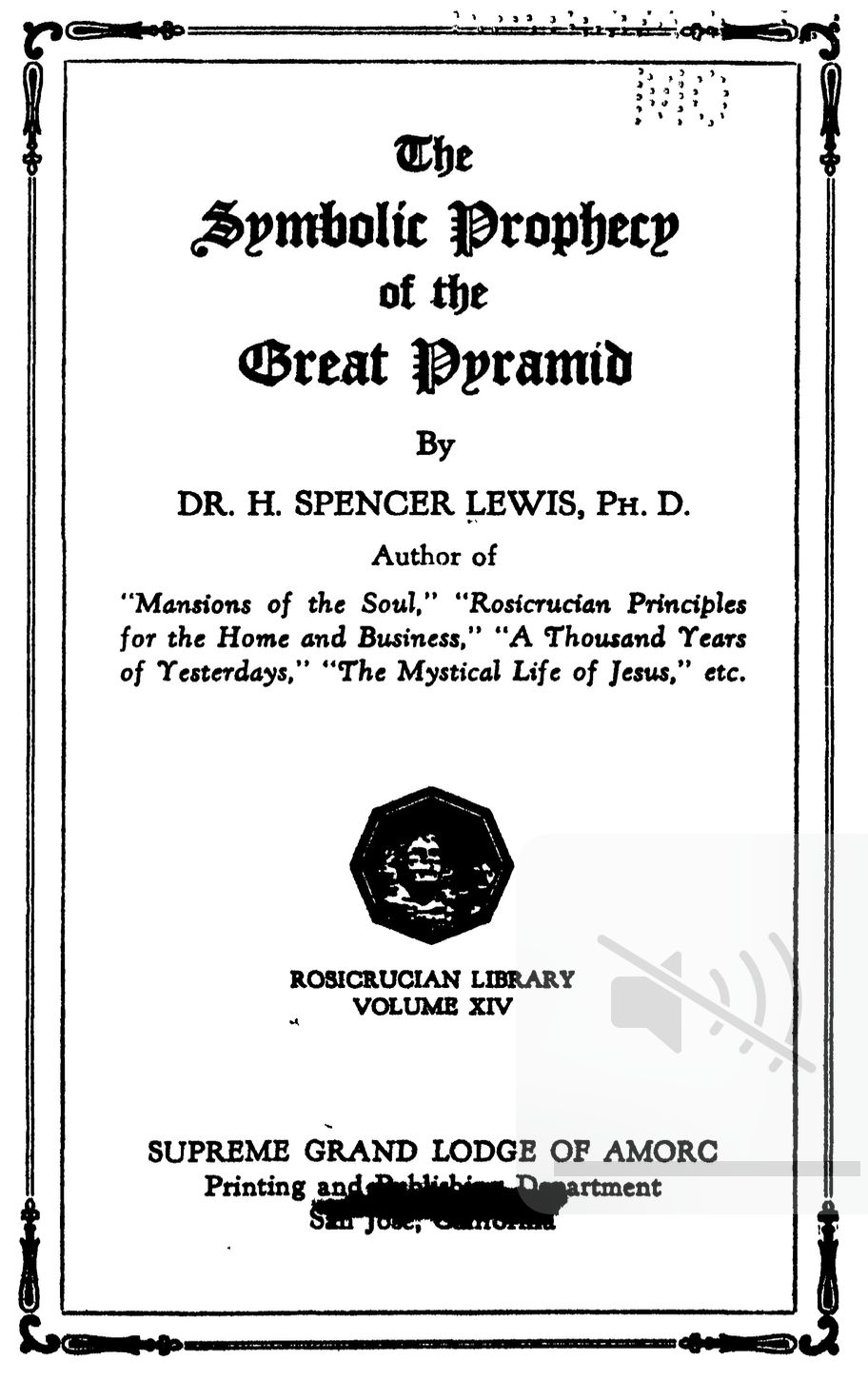
The Symbolic Prophecy of the Great Pyramid by H. Spencer Lewis
A synthesis of the core arguments and evidence presented in “The Symbolic Prophecy of the Great Pyramid."
https://archive.org/details/in.ernet.dli.2015.75033/page/n9/mode/2up
The central thesis posits that the Great Pyramid of Gizeh was not constructed as a tomb for a pharaoh, but as a multifunctional monument of profound mystical and scientific significance. It served as a temple for initiation ceremonies, an archive for the preservation of advanced knowledge, and a prophetic timeline of human history encoded in a universal language of mathematics and astronomy.
The evidence for this interpretation is drawn from its unique geographical placement at the exact center of the Earth's landmass, its construction with a precision and scale that defies the known technological capabilities of its era, and its dimensional measurements which precisely correspond to complex astronomical values such as the length of the solar year. The internal structure, including its passages and chambers, is interpreted as a chronological map forecasting major historical events from the biblical Exodus to the 20th century and beyond.
The advanced knowledge required for its creation is argued to be the inheritance of a lost, highly advanced civilization—potentially Atlantis or Lemuria—whose survivors brought their wisdom to Egypt. Recent archaeological discoveries, particularly the unearthing of a subterranean subway and chamber complex between the Sphinx and the second pyramid by Dr. Selim Hassan, are presented as tangible verification of ancient mystical traditions that support the book's primary claims, challenging long-held denials from mainstream scientific authorities.
I. The True Purpose of the Great Pyramid
The foundational argument presented is that the Great Pyramid's purpose has been misunderstood. It is contended that the structure was conceived and built not as an act of vanity by a king, but as a sacred repository of wisdom by the enlightened leaders of ancient mystery schools.
A Temple of Mystical Initiation
The primary function of the Great Pyramid was to serve as a temple for mystical initiation. This stands in direct contrast to the popular, though allegedly erroneous, belief that it was a tomb.
• Ancient Traditions: The thesis is supported by "many ancient traditions" and "secret writings" which contend the Pyramid was used exclusively for sacred ceremonies.
• The Initiation Complex: The area around the Pyramid, including the Sphinx and its adjoining temples, formed a larger initiation complex. Traditions describe a ceremonial courtyard before the Sphinx where candidates began their journey, passing through a secret entrance and subterranean passages into the Pyramid itself. The recently excavated temple next to the Sphinx is identified as a preparation chamber for these initiates.
• Symbolic Chambers: The internal chambers correspond to stages of initiation. The so-called King's Chamber, containing a lidless coffer distinct from any burial sarcophagus, was the site for symbolic ceremonies involving the laws of transition, regeneration, resurrection, and reincarnation. The Grand Gallery is referred to as the "Hall of Illumination," representing the candidate's symbolic ascent toward mystical Light.
• A Deliberate Deception: The idea that the Pyramid was a tomb was a notion "tolerated in the minds of the public" to conceal its true, sacred purpose from the uninitiated. The secret entranceways were cleverly hidden and only revealed to those who had proven worthy through sufficient test and trial.
A Monument for Preserving Knowledge
A secondary, yet crucial, purpose was to create a permanent, indestructible archive of the highest scientific and spiritual knowledge possessed by the ancients.
• A Universal Language: The builders understood that written languages and symbols could be lost over time. They therefore encoded their wisdom using the universal and eternal principles of mathematics, geometry, and astronomy.
• Repository of Science: Ancient writers like the Coptic Masoudi are cited, whose manuscripts state that the Pyramid contains "the wisdom and acquirements in the different arts and sciences," including arithmetic, geometry, and knowledge of the stars, preserved for future generations.
• Biblical and Historical Names: Ancient texts refer to the Pyramid with names that allude to its role as a repository of wisdom, such as the "Pillar of Enoch" and, in the Egyptian "Book of the Dead," "The Temple of Amen" (The Secret House of the Hidden One) and "The House of Light."
II. The Physical and Scientific Evidence
The argument for the Pyramid's mystical purpose is grounded in an analysis of its physical characteristics, which are presented as evidence of a level of scientific knowledge far exceeding that of ancient Egypt.
Geographical and Astronomical Significance
The precise location and alignment of the Great Pyramid are considered proof of its builders' advanced understanding of global geography and cosmology.
• Geographical Center: The Pyramid is situated at the precise center of the land surface of the Earth. This indicates a complete knowledge of world geography at a time when it is believed man knew of no land west of Gibraltar or east of modern Iraq.
• Astronomical Alignment: The structure is perfectly oriented to the cardinal points. Passageways were aligned with celestial bodies, such as the pole star of that era (Alpha Draconis), for astronomical observations. Its location also has a definite relationship to the sun and its daily movements.
The Mystery of its Construction
The construction of the Pyramid presents an engineering problem that mystifies modern science and suggests a lost technology.
• Scale and Materials: The monument was built with enormous stones, most greater in height than a human, quarried many miles away. The idea that this was accomplished by thousands of slaves is dismissed as inefficient and impractical.
• Advanced Tools and Chemistry: The building of the first masonry pyramids around 3000 B.C. marks a sudden technological leap from previous mudbrick structures. This required the sudden appearance of tools capable of carving limestone and a sophisticated knowledge of chemistry to create a cement, applied in layers as thin as a sheet of newspaper, with adhesive properties "far exceeding any cement in use today."
• Knowledge of Physics: The placement of the huge blocks could only have been achieved through a masterful application of the laws of leverage.
The Source of the Knowledge: A Lost Civilization
The sudden emergence of the scientific, mathematical, and engineering knowledge required to build the Great Pyramid in a period of just 150 years (c. 3000 B.C. to 2850 B.C.) is attributed to an external influence.
• The Theory: The knowledge came from survivors of a highly advanced, preceding civilization that was destroyed in a cataclysm. This theory is founded on "strange tales the Egyptians told" and architectural similarities across the globe.
• Evidence of Lemuria and Atlantis: An ancient Egyptian scroll recounts the tale of a sailor shipwrecked on an island of wise people in the Indian Ocean, a land which later vanished. The timing of this legend corresponds to the Egyptians' sudden acquisition of knowledge. This is linked to recent discoveries of a vast submerged plateau in the Indian Ocean. Similarities between Egyptian, Aztec, and Mayan pyramids are also cited as evidence of a common, lost origin, possibly the continent of Atlantis.
• The Builders: It is proposed that survivors of this lost race, finding their own kind becoming extinct around 2900 B.C., built the Great Pyramid as a "lasting monument to the great knowledge they inherited from their forebears." King Cheops (Khufu) is thought to have permitted its construction, allowing it to be dedicated to him while its builders used it for their own higher purposes.
III. The Prophecy of Events
The most significant claim is that the Great Pyramid is a monument of prophecy, with its dimensions forming a detailed timeline of human history.
The Universal Unit of Measurement
To create this prophetic timeline, the builders established a universal unit of measurement derived from the Earth itself.
• The Pyramid Inch: The unit used is the "Pyramid inch," which is equivalent to the primitive Polar Diameter inch and is almost identical to the ancient Hebrew and British inch. The Earth's Polar Diameter measures 500,000,000 Pyramid inches.
• Symbolic Etymology: The very name "Pyramid" is derived from the Phoenician purim-middoh, meaning "light-measures," or revelations through measurements.
Encoding Astronomical and Historical Data
Using the Pyramid inch, the builders embedded precise astronomical and historical data into the structure's dimensions.
• Astronomical Data:
The Solar Year: The perimeter of the Pyramid's base is 36,524.2 inches, which is exactly 100 times the length of the solar year (365.242 days).
The Solar Cycle: The height of the Pyramid to its original apex stone is 5,813 inches, which is the radius of a circle whose circumference is 36,524.2 inches. The height therefore represents the radius of the solar cycle.
Other Cycles: Other measurements encode the true orbital year (365.259 days) and the sidereal year (a measurement of 36,525.6 inches).
• The Prophetic Timeline: The internal passageways and chambers, when measured in Pyramid inches, map out a timeline of history where one inch corresponds to one year. Intersections of lines, floors, and walls mark significant dates. The following table summarizes key events prophesied, as interpreted by researchers such as David Davidson.
April 4, 1486 B.C.
Prophetic indication: Intersection of Ascending and Descending Passages
Historical event: Exodus of the Israelites from Egypt
October 4, 4 B.C.
Prophetic indication: Intersection of Queen’s Chamber and Ascending Passage floor lines
Historical event: Birth of Jesus the Christ
April 5, 30 A.D.
Prophetic indication: A key measurement in the timeline
Historical event: The Crucifixion
August 4–5, 1914
Prophetic indication: Measurement to the entrance of the first low passage
Historical event: Germany’s mobilization and the beginning of World War I
January 31, 1917
Prophetic indication: Terminal point of a so-called “index”
Historical event: United States “spiritually contacts” the Great War
November 10–11, 1918
Prophetic indication: End of the first low passage
Historical event: Flight of the German Kaiser and the Armistice
October 29, 1929
Prophetic indication: A specific measurement in inches
Historical event: The great financial crash and the start of the Great Depression
September 16, 1936
Prophetic indication: Measurements reaching the King’s Chamber (“Hall of Judgment”)
Historical event: Prophesied a great change in the U.S. government
January 31, 1947
Prophetic indication: The southern edge of the Pyramid’s apex
Historical event: Prophesied completion of a period of regeneration
August 20, 1953
Prophetic indication: A future date of culmination
Historical event: Culmination of the event that began in 1936
IV. Verification Through Modern Discovery
The historical claims of scientists and authorities who have denied the mystical interpretations are contrasted with recent archaeological findings that appear to confirm the ancient traditions.
• A History of Denial: For centuries, authorities have dismissed claims of secret passages and underground chambers as "mystical fiction." It is noted that these same authorities once denied the existence of the temple adjoining the Sphinx and the courtyard before it, both of which have since been definitively excavated.
• The Discoveries of Dr. Selim Hassan: The work of Dr. Selim Hassan of the University of Cairo is highlighted as pivotal. In the early 1930s, his excavations unearthed what he described as a "subway used by the ancient Egyptians of 5,000 years ago."
This subway, a gigantic stone causeway, connects the second pyramid to the temple of the Sphinx.
From this subway, a series of shafts was unearthed leading down more than 125 feet.
The shafts end in a complex of rooms, including a court flanked by seven side chambers containing huge sarcophagi of basalt and granite.
Among the discoveries was the head of a statue in the artistic style of the Amenhotep regime.
• Confirmation of Mystical Tradition: These findings are presented as direct, physical verification of the diagrams and traditions preserved by the mystery schools. They demonstrate that the territory around the Pyramid had not been fully explored, as was claimed, and lend powerful credence to the idea that much more remains hidden, and that the mystical view of the Pyramid and its environs may be more accurate than previously admitted.
AndreasTrevor Grassi on the Temple Beneath the Sphinx
Core Thesis
The video presents cumulative evidence for a network of ancient, subterranean tunnels connecting the Sphinx to all three main pyramids on the Giza Plateau.
This episode focuses on historical and esoteric evidence, particularly from the early 20th century, to validate the existence of these structures.
Key Historical Evidence from the 1930s
Harvey Spencer Lewis (1936):
Published "The Symbolic Prophecy of the Great Pyramid."
Included detailed maps and cross-sections showing tunnels from the Sphinx to the pyramids.
Claimed his information came from ancient Rosicrucian documents preserved by mystery schools, supplemented by contemporary excavations (referencing Selim Hassan's work).
H.C. Randall-Stevens (1935):
Published "A Voice Out of Egypt."
Contained very similar diagrams to Lewis's.
Claimed his information came from channeled communications with Atlantean beings.
Common Elements in Their Diagrams:
A large chamber beneath the Sphinx's body.
A tunnel running from the Sphinx, under the causeway, branching to the three pyramids.
Various shafts for light and ventilation.
The "Source Map" Revelation
The New Evidence: Trevor Grassi obtained, via Grandmaster Timothy Hogan, what is purported to be the original source map used by both Lewis and Randall-Stevens.
Origin of the Map:
Created by Émile Dantinne (Sar Hieronymus), a prominent Rosicrucian and Templar, during a trip to Egypt in 1932.
Dantinne was reportedly initiated in the Great Pyramid and was a colleague/initiator of Harvey Spencer Lewis.
The map is part of the archives of a modern Templar order.
Significance:
Suggests the published maps were based on a single, older source within esoteric circles.
Crucially, Dantinne's presence in Egypt in 1932 coincides with Selim Hassan's major excavations. The implication is that Dantinne may have had firsthand knowledge or access to the discovered tunnels, moving the maps from "legend" to potential eyewitness documentation.
Context: Mystery Schools and Knowledge Control
Purpose of Mystery Schools: Described as ancient institutions for transmitting advanced spiritual, scientific, and philosophical knowledge through initiations designed to test an applicant's ethical worthiness.
Modern Infiltration: The video alleges that many modern mystery schools (Freemasonry, Rosicrucians, Templars) have been infiltrated and corrupted at high levels, particularly by the 33rd degree of Scottish Rite Freemasonry.
Control of Narrative: This corrupted hierarchy is presented as having a vested interest in suppressing and controlling the disclosure of historical truths, including those at Giza.
Example Given: The 1998 reversal of Dr. Zahi Hawass, who went from advocating opening chambers under the Sphinx to denying their existence, is linked to pressure from media mogul and alleged 33rd-degree Freemason Rupert Murdoch, who gained control of the related TV project.
Corroborating Evidence and Findings
Selim Hassan's Excavations (1920s-30s): His work, which revealed a "secret city" and numerous deep shafts, is cited as physical corroboration for the tunnel legends.
Joseph Schor Expedition (1990s): An article from the A.R.E. journal (Venture Inward, 1997) is highlighted where Schor states a "99% certainty" of a large chamber (25' x 40') under the Sphinx, accessible via a shaft.
The "Coffer Project" Scans: Subsurface scans are cited showing massive, deep (1km+) tubular anomalies running along the causeway.
Bill Brown's GPR Scans (2006): Conducted along the causeway, they revealed significant subsurface anomalies. Authorities blocked scans in specific areas, interpreted as an admission of what lies beneath.
2025 Scientific Paper: A new non-destructive scan study confirmed two anomalies/voids behind the eastern face of the Menkaure Pyramid, potentially aligning with the tunnel entry point shown on the Rosicrucian maps.
Physical Anomalies: Sand falling endlessly into cracks on the causeway paving stones is presented as anecdotal evidence of vast hollow spaces below.
Conclusion
The combined evidence—historical maps with a credible source, 20th-century excavation reports, modern geophysical scans, and anecdotal observations—forms a compelling case for the existence of a subterranean network at Giza.
The suppression of this information is attributed to a corrupted stratum within certain mystery schools (specifically high-degree Freemasonry) seeking to maintain control over the historical narrative.
The release of the "Dantinne source map" is presented as a key piece of historical validation for the theory, bridging esoteric tradition with the archaeological activity of the 1930s.
Related:
Andreas