Comments
Check out our elevator pitch or sign in
Next Up...
Trevor Grassi on the Temple Beneath the Sphinx
Core Thesis
The video presents cumulative evidence for a network of ancient, subterranean tunnels connecting the Sphinx to all three main pyramids on the Giza Plateau.
This episode focuses on historical and esoteric evidence, particularly from the early 20th century, to validate the existence of these structures.
Key Historical Evidence from the 1930s
Harvey Spencer Lewis (1936):
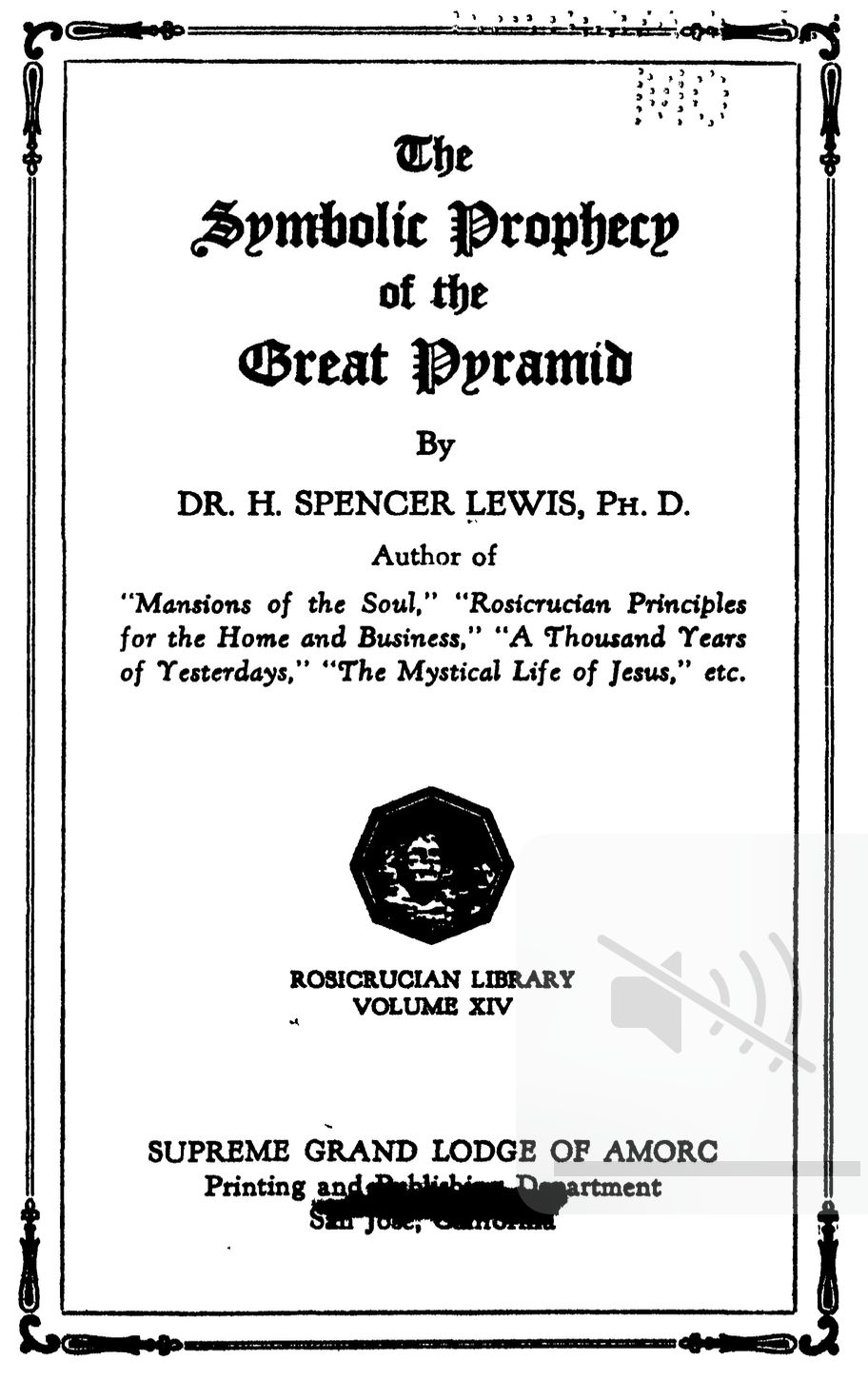
Published "The Symbolic Prophecy of the Great Pyramid."
Included detailed maps and cross-sections showing tunnels from the Sphinx to the pyramids.
Claimed his information came from ancient Rosicrucian documents preserved by mystery schools, supplemented by contemporary excavations (referencing Selim Hassan's work).
H.C. Randall-Stevens (1935):
Published "A Voice Out of Egypt."
Contained very similar diagrams to Lewis's.
Claimed his information came from channeled communications with Atlantean beings.
Common Elements in Their Diagrams:
A large chamber beneath the Sphinx's body.
A tunnel running from the Sphinx, under the causeway, branching to the three pyramids.
Various shafts for light and ventilation.
The "Source Map" Revelation
The New Evidence: Trevor Grassi obtained, via Grandmaster Timothy Hogan, what is purported to be the original source map used by both Lewis and Randall-Stevens.
Origin of the Map:
Created by Émile Dantinne (Sar Hieronymus), a prominent Rosicrucian and Templar, during a trip to Egypt in 1932.
Dantinne was reportedly initiated in the Great Pyramid and was a colleague/initiator of Harvey Spencer Lewis.
The map is part of the archives of a modern Templar order.
Significance:
Suggests the published maps were based on a single, older source within esoteric circles.
Crucially, Dantinne's presence in Egypt in 1932 coincides with Selim Hassan's major excavations. The implication is that Dantinne may have had firsthand knowledge or access to the discovered tunnels, moving the maps from "legend" to potential eyewitness documentation.
Context: Mystery Schools and Knowledge Control
Purpose of Mystery Schools: Described as ancient institutions for transmitting advanced spiritual, scientific, and philosophical knowledge through initiations designed to test an applicant's ethical worthiness.
Modern Infiltration: The video alleges that many modern mystery schools (Freemasonry, Rosicrucians, Templars) have been infiltrated and corrupted at high levels, particularly by the 33rd degree of Scottish Rite Freemasonry.
Control of Narrative: This corrupted hierarchy is presented as having a vested interest in suppressing and controlling the disclosure of historical truths, including those at Giza.
Example Given: The 1998 reversal of Dr. Zahi Hawass, who went from advocating opening chambers under the Sphinx to denying their existence, is linked to pressure from media mogul and alleged 33rd-degree Freemason Rupert Murdoch, who gained control of the related TV project.
Corroborating Evidence and Findings
Selim Hassan's Excavations (1920s-30s): His work, which revealed a "secret city" and numerous deep shafts, is cited as physical corroboration for the tunnel legends.
Joseph Schor Expedition (1990s): An article from the A.R.E. journal (Venture Inward, 1997) is highlighted where Schor states a "99% certainty" of a large chamber (25' x 40') under the Sphinx, accessible via a shaft.
The "Coffer Project" Scans: Subsurface scans are cited showing massive, deep (1km+) tubular anomalies running along the causeway.
Bill Brown's GPR Scans (2006): Conducted along the causeway, they revealed significant subsurface anomalies. Authorities blocked scans in specific areas, interpreted as an admission of what lies beneath.
2025 Scientific Paper: A new non-destructive scan study confirmed two anomalies/voids behind the eastern face of the Menkaure Pyramid, potentially aligning with the tunnel entry point shown on the Rosicrucian maps.
Physical Anomalies: Sand falling endlessly into cracks on the causeway paving stones is presented as anecdotal evidence of vast hollow spaces below.
Conclusion
The combined evidence—historical maps with a credible source, 20th-century excavation reports, modern geophysical scans, and anecdotal observations—forms a compelling case for the existence of a subterranean network at Giza.
The suppression of this information is attributed to a corrupted stratum within certain mystery schools (specifically high-degree Freemasonry) seeking to maintain control over the historical narrative.
The release of the "Dantinne source map" is presented as a key piece of historical validation for the theory, bridging esoteric tradition with the archaeological activity of the 1930s.
Related:
 Andreas
The Universal Life Force – Reconciling Chi, Prana, and Zero-Point Energy
For millennia, across cultures and continents, spiritual traditions have described a universal life force, a subtle energy that animates all of creation. This vital field was the perceived foundation of existence, known as Chi in Chinese philosophy—the animating principle of the universe—and as Prana in the Vedic traditions of India, the very breath of the cosmos. More recent Western esoteric concepts like Vril or Orgone echoed this same primordial truth: that we are immersed in an all-pervading field of energy that can be harnessed for power, healing, and transcendence. Now, at the frontiers of modern physics, through the exploration of quantum mechanics and cosmology, we are independently discovering this very same field. Science is providing a new language for what was once considered purely mystical, bridging an ancient gap and demonstrating that these concepts are not opposing worldviews, but two sides of the same profound coin.
What if the ethereal, life-giving medium of the ancients and the “Zero-Point Energy” of modern physicists are, in fact, one and the same?
The Modern Aether: The Physics of Zero-Point Energy (ZPE)
To understand the universal life force from a modern perspective, we must first grasp the concept of Zero-Point Energy (ZPE) —the foundational layer of our physical reality. As described by black project engineer Paul Czysz, it is the background upon which the universe exists—an “ocean of energy,” that constitutes the very fabric of spacetime itself.
Zero-Point Energy is the energy that remains even when a system is cooled to absolute zero and all thermal motion ceases. As Czysz explains, “when everything comes down to rest, there’s still energy left.” It's a dynamic sea of “virtual photons” constantly popping in and out of existence. In essence, ZPE is the modern scientific conception of the ancient “aether”—not a physical substance, but a roiling quantum field that permeates everything, in every moment. The existence of this field is not speculation; it is confirmed by tangible, measurable effects and provides stunningly elegant solutions to some of physics’ most fundamental puzzles.
The first proof of its reality came from the Casimir effect, where two conductive plates in a vacuum are pushed together by the pressure of the surrounding ZPE field. In his 1984 paper, “Extracting Energy and Heat from the Vacuum via the Casimir Effect,” physicist Robert Forward demonstrated that this force could be used to do real work, proving conclusively that ZPE is not just a theoretical artifact but a tangible and extractable energy source. While Forward proved that ZPE could be harnessed for external work, Dr. Hal Puthoff's subsequent research revealed an even more intimate role: ZPE is the very force that sustains the structure of matter itself.
In a landmark 1987 paper, “Ground state of hydrogen as a zero-point-fluctuation-determined state,” Puthoff answered the question that had long puzzled physicists: why is the atom stable? His work demonstrated that the electron neither flies off nor spirals into the nucleus because it exists in a perfect equilibrium, a constant state of energy exchange with the ZPE field. This is a staggering realization: every piece of matter in the universe is not a static, isolated thing, but is constantly drinking from an invisible, energetic river, sustained in its very existence by a ceaseless exchange with the cosmos. Building on the work of physicist Andrei Sakharov, Puthoff went on to show that this same field could be the underlying source of mass, inertia, and gravity. In this model, what we perceive as gravity is a gradient in the ZPE field; massive objects create a “shadow” of lower ZPE pressure, and other objects are pushed toward them by the higher pressure of the surrounding universal energy sea. It is now clear that the vacuum of space is not empty. It's a vibrant and energetic medium that underpins all matter and force, providing the scientific foundation for its profound connection to life and consciousness.
How ZPE Manifests in Nature and Consciousness
Having established ZPE as the substrate of the cosmos, we now turn from the cosmic scale to its connection with biological life. This link is the key to understanding ZPE as the scientific basis for the life force known as Chi and Prana. It is how the universe of inanimate energy gives rise to the animated, self-aware world we experience. Our very perception of reality is governed by this field. As researcher Bob Greenyer explains, our sense of time is a product of biological processes driven by the behavior of electrons. Since we know electrons are in a constant state of exchange with the ZPE field, our experience of time’s passage is a direct consequence of our interaction with this universal energy.
Nature, it appears, creates order from the chaos of this quantum sea through two fundamental structures: the vortex, which coheres energy to a central point, and the ring soliton, or torus, a stable, self-reinforcing energy pattern. “Ultimately,” Greenyer concludes, “life is driven by vortexes.” We see this pattern emerge in experiments that tap the ZPE field, where a recurring toroidal vortex structure forms. Greenyer compares its shape to an apple, noting that the core is where “the vortex is pulling in the matter, the chi, the zero point energy.” Just as the apple is the archetypal fruit of knowledge in myth, its toroidal shape reveals nature’s deepest secret, hidden in plain sight—the fundamental geometry through which the universal life force organizes itself into stable, living forms.
This energetic medium is the physical substrate of universal information and consciousness. What ancient traditions called the “Akashic Record,” Greenyer describes in physical terms: a universal, coherent, superfluid medium of “relic neutrinos” that pervades all matter and shares a single, unified wave function. Information encoded into this field via fractal toroidal moments—such as those generated by the human brain—persists for all time and is accessible instantaneously anywhere in the universe. This provides a stunning physical framework for phenomena that have long defied conventional explanation. It is no coincidence that Dr. Hal Puthoff was a leading expert in both ZPE research and government-sponsored remote viewing programs; these seemingly disparate fields draw from the same underlying, interconnected reality. The flow of Chi through the body and the non-local information of the Akashic record are different manifestations of the same ZPE-driven, vortex-based dynamics that govern all life.
Technology as Modern Alchemy
The ability to harness Zero-Point Energy marks a pivotal moment in human history. The emerging technologies that tap this field are the alembics and athanors of a modern, scientific alchemy. They allow for a direct, conscious interaction with the fundamental energy of the universe, the prima materia of existence, transmuting the leaden assumptions of an empty vacuum into the golden reality of a living cosmos. The capabilities of these technologies are so profound they sound like magic, yet they are rooted in the physics of the ZPE field.
The pioneering work of Ken Shoulders explored the creation of stable, self-organizing balls of cold plasma—Exotic Vacuum Objects (EVOs)—which he believed drew their energy directly from the vacuum itself. Shoulders regarded the implications as nothing short of revolutionary: in his view, such entities could resolve both energy scarcity and propulsion limitations, and an EVO enveloping an object could even enable its disappearance, effectively a form of teleportation. His ideas find an intriguing parallel in work by Frank Mead and George Miley, who describe a “dense plasma focus fusion system” exhibiting remarkable performance. Their experiments reportedly achieved a Q factor of three—producing three times more energy than supplied—with projections suggesting the possibility of reaching values between three and six. This system could generate gigawatts of excess energy to power cities, gravity devices, and advanced communication systems. Dr. Hal Puthoff identifies precisely this combination of neutronic fusion and zero point energy, as the likely power source for observed UFO phenomena.
For propulsion, creating a plasma sheath around a craft polarizes the vacuum, reducing interaction with the ZPE field. Since inertia is an effect of this interaction, the craft effectively becomes “slippery” to spacetime, allowing for incredible speeds and maneuverability. In a paper from the Air Force Research Lab, Frank Mead describes another concept: a laser light craft that functions as a “sailboat in the sky,” riding on waves intentionally created in the ZPE field.
Crucially, these technologies validate the existence of a universal energy field by demonstrating that tapping into it does not violate known physical laws. As a paper by Hal Puthoff and Daniel Cole explains, extracting ZPE is not creating energy from nothing. It is simply adding an extra input into the system—the boundless energy of spacetime itself. We are not breaking the laws of thermodynamics; we are finally working with a complete picture of them. The ability to engineer this energy provides tangible proof of this once “subtle” field, setting the stage for its more profound, reality-bending applications.
ZPE, Teleportation, and Non-Locality
The most profound implication of mastering Zero-Point Energy is the ability to engineer spacetime itself. By understanding that spacetime is an energetic medium, we find that it can be acted upon, challenging our most fundamental assumptions about physical reality.
The scientific basis for teleportation is macroscopic quantum tunneling. Just as a quantum particle can tunnel through an energy barrier, a large object can “tunnel through spacetime itself” by moving the ZPE “out of the way.” This phenomenon has allegedly been recorded, with orbiting drone vehicles (ODVs) creating a “bubble” to teleport a larger craft. Physicist John Cramer describes an even more precise protocol: you don’t travel through a wormhole, you send the wormhole’s endpoint—a stabilized plasma orb—to the destination. Once it arrives, the wormhole is expanded, and you simply “walk out” on the other side, experiencing the journey as instantaneous.
The manipulation of ZPE also provides a direct path to traversable wormholes and time dilation. A Defense Intelligence Reference Document (DIRD) by Dr. Eric W. Davis concludes that wormholes require an “arbitrarily small” amount of “negative energy.” It is crucial to understand that this “negative energy” is not some exotic, undiscovered substance. It is simply the energy of the vacuum itself, the ZPE field, when its energy density is lowered relative to the surrounding spacetime. The secret was not finding a new energy, but realizing the “ground state” we inhabit is not the true ground state. Furthermore, as Dr. Hal Puthoff explains in his DIRD paper “Advanced Space Propulsion Based on Vacuum (Spacetime Metric) Engineering,” manipulating spacetime is synonymous with manipulating time. This means a traveler could journey to a distant star system in what seems to them to be mere minutes, while years pass for those left behind. These extraordinary principles resonate deeply with spiritual concepts like bilocation, astral travel, and non-local consciousness, which can now be understood as intuitive experiences of the fundamental physics of quantum tunneling and entanglement, made possible by our inherent connection to the universal ZPE field.
The Unification of Science and Spirit
This exploration has brought us to a remarkable convergence. The “subtle energy” known for millennia as Chi and Prana is not a metaphor. It is a physical reality that modern science is now identifying, measuring, and beginning to harness as Zero-Point Energy. The language is different, but the truth it describes is the same. The ancient wisdom of the mystics and the modern discoveries of the physicists are finally speaking in unison about the fundamental nature of our universe.
The evidence for this unification is multifaceted and compelling:
• Zero-Point Energy is a proven, foundational field of the cosmos, providing the scientific explanation for mass, gravity, and the very stability of matter.
• Life and consciousness are not accidents in a dead universe, but are expressions of complex, ordered vortices that draw their structure and animation directly from this universal field.
• Advanced technology can now interact with and harness this energy, demonstrating its tangible existence and its potential to bend the rules of our perceived reality, from unlimited power to teleportation.
The implications of this synthesis are world-changing. Humanity is on the verge of an age of abundance, where clean, limitless energy can solve many of our most pressing global challenges. We stand at the threshold of a new era of exploration, not just of the stars, but of the inner cosmos of consciousness. This is not the discovery of something new. It is the rediscovery of an eternal truth. We exist within a living, conscious, and deeply interconnected universe.
AndreasThe Science and Philosophy of Ether, the Spherical Cosmos, and the World Soul
A detailed critique of modern cosmology and physics, arguing for a fundamental re-evaluation of core concepts like space, matter, and the historical narrative of science itself. The analysis posits that the prevailing scientific worldview is founded on historical distortions and a flawed, reductionist methodology that excludes consciousness as a primary component of reality.
The central arguments are as follows:
Historical Misinterpretation:
Widely accepted scientific histories, particularly concerning Isaac Newton, are inaccurate. Newton's actual physics, for instance, held that all motion requires a continuous force, a concept diametrically opposed to the principle of inertia central to "Newtonian mechanics." This illustrates how foundational ideas have been altered and simplified over time.
The Archetype of the Sphere:
The ancient conception of the cosmos as a finite, all-encompassing sphere with no "outside" represents a coherent metaphysical system. This "sphere metaphysics" integrated all life through a universal "World Soul" (Anima Mundi), providing a sense of cosmic belonging that has been shattered by the modern view of a meaningless, mechanistic universe.
The Indispensability of the Ether:
The 19th-century concept of a mechanical "ether" as the medium for light was abandoned following the reportedly "null" results of the Michelson-Morley experiments and the rise of Einstein's relativity. However, this historical account is flawed; the experiments consistently showed small, positive results. The concept of the ether is, in fact, indispensable for physics and has continually reappeared in other forms, such as the quantum vacuum's zero-point energy.
The Primacy of Consciousness:
The most profound failure of modern science is its reductionism—the attempt to explain life and consciousness as byproducts of fundamentally "dead" matter. Any cosmological theory that does not treat consciousness as an integral, foundational aspect of the universe is inherently incomplete and leads to insoluble contradictions. The fundamental fields of the universe are ultimately proposed to be fields of consciousness and will.
In essence, the analysis calls for a new scientific paradigm that reunites physics with philosophy, reinstates a form of the ether concept, and places consciousness at the core of cosmic reality.
1. Re-evaluating the History of Physics
A critical examination of the history of science reveals that established narratives often misrepresent the original theories of key figures, leading to a distorted understanding of scientific evolution.
The True Newtonian Physics:
The common understanding of "Newtonian mechanics," particularly the principle of inertia (that uniform rectilinear motion is force-free), is a significant departure from Isaac Newton's own beliefs. Newton was convinced that any motion, regardless of its nature, required a continuous, sustaining force to maintain it. The version of his work that became standard was heavily influenced and reinterpreted by figures like Leibniz, creating a simplified and altered "school mechanics" that is not faithful to Newton's original, more subtle interpretations.
Einstein versus Newton: Popularization and Legacy:
A key difference between the two physicists lies in their relationship with public perception. Albert Einstein was the first great popularizer of his own theories, skillfully using his media stardom in the 1920s to shape his own legacy. Consequently, most modern interpretations and perceived oddities of relativity theory can be traced back to Einstein himself. In contrast, Newton's work was largely interpreted and popularized by others, leading to the aforementioned distortions.
2. The Archetype of the Sphere: Ancient and Modern Cosmology
The geometric form of the sphere has served as a central, archetypal figure in cosmological thought for millennia, representing a model of a complete and integrated universe.
The Ancient Spherical Cosmos:
For nearly 2,500 years before Copernicus, the cosmos was almost exclusively conceived as a perfect sphere. This model was not merely geometric but deeply metaphysical. A crucial dogma of this Aristotelian worldview was that the cosmic sphere had no outside. The existence of an "outside" would open the door to the possibility of other cosmic spheres or worlds, a concept that was fiercely rejected. The realm beyond the sphere was considered a non-spatial, non-temporal domain of the divine.
The World Soul (Anima Mundi):
This spherical cosmos was not empty. Following Plato's Timaeus, it was understood to be completely filled with a "World Soul," an all-encompassing life force. Every single living, sentient being was considered an integral part of this World Soul, incapable of "falling out" of the totality. This created a coherent "sphere metaphysics" where everything had its place within a single, shared interior space.
From Finite to Infinite:
The concept of the World Soul was revived in the Renaissance by Marsilio Ficino, still within the context of a finite sphere. It was Giordano Bruno who first extended this idea to an infinite cosmos, which he metaphorically described as an "infinite sphere."
Parallels with Modern Cosmology:
The ancient Aristotelian universe bears a surprising resemblance to the modern Big Bang model. Both posit a self-contained totality. This raises a critical and often ignored question for modern cosmologists: "What is space expanding into?" If space is not expanding into a pre-existing, larger space (a "hyperspace"), then the claim of expansion is a pure, unproven assertion.
The Modern Alienation:
Referencing the work of Peter Sloterdijk, the modern consciousness is described as having been "catapulted" out of this containing sphere into a "numbing nothingness." The contemporary cosmological model presents a universe of mechanistic, senseless, and ultimately dead processes, leaving humanity feeling isolated and thrown back upon itself. This psychological void fuels counter-movements like astrology, which represent an attempt to regain a sense of integration with the cosmos.
3. The Contentious History of the Ether
The concept of an "ether"—a fundamental substance or medium filling all of space—has been a persistent, if controversial, idea in both Western and Eastern thought.
Ancient and Asian Conceptions:
The ether was originally conceived as the "quintessence" or fifth element, a fine, subtle substance from which the celestial bodies were formed. A parallel concept exists in Asian philosophy as "Akasha," which is seen alternately as a form of consciousness radiation (Buddhism) or as space itself (Hinduism). This ambiguity—whether the medium is in space or is space—is a recurring theme.
The 19th-Century Problem of Light:
After the work of Thomas Young and others proved the wave-like nature of light, physics was confronted with a major problem: if light is a wave, what is the medium that is waving? The hypothesized medium was the ether. This led to profound paradoxes, as the ether had to possess contradictory properties: it needed to be thousands of times denser than steel to support the immense speed of light waves, yet simultaneously be so fine that it could permeate all matter without resistance.
Field Theory vs. Ether Theory:
Michael Faraday's introduction of the "field" concept in the 19th century created a parallel line of thought. A distinction was drawn between the two ideas:
Ether: Was conceived as a quasi-material, a subtle substance.
Field: Was conceived as explicitly non-material. Einstein particularly admired this aspect of Maxwell's field theory, as it dispensed with mechanical, material components.
4. A Critical Perspective on Relativity and the Ether's "Demise"
The rise of Einstein's theory of relativity is commonly credited with abolishing the need for an ether, a narrative that is presented here as a significant oversimplification.
The Michelson-Morley Experiments:
These famous experiments were designed to detect the "ether wind" created by Earth's motion through a stationary ether. The canonical story is that they produced a "null result," proving the ether did not exist. This is presented as a historical falsehood. In reality, the experiments never produced a perfect null result; they consistently measured small but persistent "ether wind" effects.
The Foundation of Special Relativity:
Einstein's theory is re-characterized not as a "relativity theory" but as an "absolutist theory." Its foundational move was to take the observed constancy of the speed of light and elevate it to a fundamental, absolute principle. To maintain this absolute, all other physical quantities—namely space and time—had to become relative and malleable. The entire framework of space-time was thus rebuilt around this single axiom.
The Ether's Apparent Abolition and Subsequent Return:
Physicists like Max von Laue celebrated relativity for having "freed" them from the vexing ether problem. The ether was declared non-existent and became a taboo topic in mainstream physics. However:
Einstein's Reversal: In a 1920 lecture, Einstein himself reversed his position, stating that physics could not do without an ether, though it had to be a new kind, different from the 19th-century mechanical model.
General Relativity: The theory of General Relativity describes space-time as a dynamic, malleable entity, which is in itself a quasi-materialistic conception.
Quantum Ether: The idea re-emerged in quantum physics through the concept of the vacuum's "zero-point energy," effectively a quantum ether.
5. A New Framework: Consciousness, Fields, and Gravity
The final and most critical part of the argument proposes a radical restructuring of physics to integrate consciousness as a fundamental property of reality.
Gravitation as a Radial Field:
An alternative theory of gravity is proposed, drawing on Renaissance philosopher Giordano Bruno. In this view, gravity is not an attractive force between particles of matter. Instead, it is the effect of a radial field that extends from the center of a celestial body outwards. At the very center, the gravitational effects would cancel out, meaning that celestial bodies are, in a fundamental sense, neither "heavy" nor "light." This model avoids the paradoxes of infinite density that plague standard gravitational theory.
The Primacy of Consciousness:
This is the central philosophical thesis.
Any theory that fails to include consciousness as an integral component is inherently reductionist. Reductionism, the attempt to explain life by reducing it to dead matter, is deemed logically impossible and leads to a "vicious circle of contradictions."
Consciousness is not a late, accidental byproduct of material evolution. It must be a fundamental property of the universe, existing at all levels and in various dimensions.
The fundamental fields of reality—the modern successor to the ether—are ultimately consciousness fields and will fields ("Willensfelder und Geistfelder").
Distinguishing the Ether from the World Soul:
A crucial distinction is made: one should not be too quick to simply equate this fundamental field/ether with the classical concept of the "World Soul." The relationship between them is complex and non-identical, representing a subject for future inquiry.
6. Conclusion and Future Outlook
The analysis concludes by asserting the necessity of reviving and reformulating the concept of the ether and fundamentally reorienting scientific inquiry.
The Ether's Necessity:
A coherent physical science is impossible without some concept of a universal medium or fundamental substrate, whether it is called "ether" or something else. To deny it is to remain trapped in an untenable materialism.
A Predicted Resurgence:
The topic of the ether is predicted to grow in importance and urgency in the coming years, as the limitations of the current paradigm become increasingly apparent.
Reuniting Science and Philosophy:
The ultimate goal is to heal the "fatal" schism between the natural sciences and the humanities. This can only be achieved by creating a unified understanding of reality that fully integrates the objective phenomena of physics with the subjective, spiritual, and conscious dimensions of existence.
Andreas